Showing posts with label Lignocellulosics. Show all posts

Saturday, October 29, 2011

Direct one-step conversion of ligninocellulosic biomass to hydrogen-enriched biofuel

The common ways for thermal conversion are fast pyrolysis and hydrothermal liquefaction.
·         The bio-oils obtained by fast pyrolysis are highly oxygenated complex mixtures, which are viscous, corrosive, and relatively unstable. The high contents of water and oxygenated compounds lead to the low HHV and the significant change of the combustion characteristics. They are not miscible with petroleum-based liquids. There is no efficient route for the upgrading needed to produce a motor fuel.
·         The bio-oils obtained by hydrothermal liquefaction are a complex mixture of ketones, aldehydes, phenols, alkenes, fatty acids, esters, aromatics, and nitrogen-containing heterocyclic compounds with high oxygen content and low heating value.


Direct One-Step Conversion of Lignin to Hydrogen-Enriched Biofuel involves in using solvent as the reaction medium and hydrogen donor with/without other catalysts, which can result in gasoline-like hydrocarbon product with high heating value and low char.

Monday, April 4, 2011

Bioconversions of lignocellulosic biomass: the points we cannot overlook

Pretreatment

• If you pretreat biomass at alkaline conditions, be sure to separate lignin before neutralization. Otherwise, the solublized lignin will be precipitated or re-deposited when pH drops.
• If you pretreat biomass at acidic conditions, be sure the temperature does not exceed 165 C. Otherwise, the lignin will condense and re-distribute through cell wall and become gel coat on the surface of pretreated fiber
• If you pretreat biomass with organosolvents, make sure to recycle/re-use the solvents.


Post-pretreatment
• If run detoxification, make sure the methods to be used with fundamental mechanisms. It is cheap and scalable.
• Recover by-products and easily and economically deal with the chemicals if any.

Enzymatic hydrolysis
• Know what biomass you are using and their sugar composition. Woody and non-woody biomass has different chemical (especially lignin and hemicelluloses) composition.
• Know the pretreatment methods you used. The modification of cell wall structure and chemical composition differ under different thermochemical pretreatments.
• Know what substrate the enzyme cocktail development has been based on. Alkaline and acidic pretreated biomass will end up different cocktail characteristics. The enzyme cocktail may need to be customized in terms of the specific pretreated biomass.


Process
• Avoid or reduce unit operations as much as possible
• Be as simple as possible for process configuration
• Use high solids if possible

Fermentation
• Use cheap nutrients if possible
• Ferment C6 and C5 sugars if possible

Friday, February 25, 2011

Hemicelluloses for fuel ethanol-A good source of information but what else can we get?

A good summary in this review paper with the following aspects:
  • various hemicelluloses structures present in lignocellulosic biomass
  •  the range of pre-treatment and hydrolysis options including the enzymatic ones
  •  the role of different microbial strains on process integration aiming to reach a meaningful consolidated bioprocessing
  • the recent trends, technical barriers and perspectives of future development are highlighted.
So far, all the review paper on biomass pretreatments cover almost the same: list the acid, alkaline, wet oxidation, organosolv, ionic liquids pretreatments and their advantages and disadvantages, based on which comes a conclusion: no ‘‘ideal” pre-treatment.

 Actually there do exist good pretreatments, which are effective under low temperature and less by-products. In addition, a milder pretreatment with an efficient process configuration is able to overcome some drawbacks.


The pretreatment I have is conducted at a temperature lower than 120 C and near neutral alkaline conditions, which significantly reduce up-front capital cost and operational cost as well as the chemicals required for neutralization. In addition, a simple process configuration is used for more practical application, which will make it more economical competitive.


My advice: do not just look at these review papers when developing your own pretreatments. They are good sources and references. Understand the fundamentals first and jump out of the box. Remember: be simple for the process.


Thursday, March 26, 2009

Acetyl group in xylan: problem or opportunity?

It is known that ~7 acetyl groups per 10 xylose units in heardwood and straws, which leads to the formation of acetic acid or acetate by peeling off during any thermal and chemical reaction.

It is quite a big amount in the pretreated hydrolyzate, which is toxic to microorganism at certain level. It is not economical by just removing it from the hydrolyzate. It should be recovered or utilized. Distillation is not efficient to recover it from the hydrolyzate. Membrane separation can achieve the goal but the capital and operating cost will kill the biorefinery if ethanol is the only product.

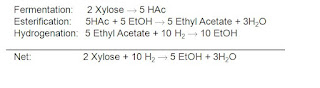
One of the approach is to produce ethanol indirectly, i.e first ferment xylose to acetic acid followed by esterification and hydrogenation. As a result, 2 unit of xylose can produce 10 unit ethanol with 10 unit hydrogen. The acetic acid can be used completely.

The questions are:

1. The yield and efficiency of fermentation to acetic acid

2. The cost of hydrogen

3. Cost of hydrogenation

4. more...

What are other alternatives to revover or remove acetic acid?

Tuesday, March 24, 2009

Cheap sugar: the key for bioethanol to survive

Bioethanol industry is facing another winter time in its history due to current cheap oil/gas price. Most people believe the price of oil will back up again sooner or later. The question is when? The good news is the incentive policy and stimulus fund from the new government that will bring the spring this industry. However, the long term survival will depend on its own economic viability. The key is the cheap sugar and apparently the renewable source is lignocellulosic biomass. Generally only 2/3 of biomass weight is carbohydrate that can be converted into monomeric sugars for fermentation. The question is how to obtain them with a high yield in a cheap way. The current hydrolysis technology is still not good enough to realize this.

Enzymatic hydrolysis is a direction for bioethanol production from lignocellulosic biomass. Ideally a or a combination of chemicals are used to remove both hemicelluloses and delignification simultaneously, the resulting solid is mostly cellulose with more exposed and accessible surface and pores, free chain ends, leading to lower enzyme loading, high enzyme selectivity, and fast rate of hydrolysis.
The cheap sugar is calling on advanced enzyme!

Tuesday, February 24, 2009

Uronic acids and metals in biomass

Uronic acids and metals in biomass will cause some problems in acid hydrolyzates.

Monday, February 16, 2009

The Effect of Lignin on Enzyme Hydrolysis and Fermentation

  • Barrier to cellulase enzymes
    – limit the efficacy of hydrolysis
  • Adsorb cellulases
    –Increase enzyme loading and therefore the cost
  • Phenloc compounds partition into biological membrances cause loss of integrity, therefore affecting their ability to serve selective barriers and enzyme matrices.

Less heavily substituted phenolics are the most inhibitory compounds
–Phenols
–Vanillin
–Hydroxylbenzaldehyde

Tuesday, January 27, 2009

Microbial pretreatment of piomass

Biological pretreatment of wood chips has attract great attention and research activities to reduce the mechanical pulping refining energy. The same principle and idea can be applied to biomass pretreatment for lignocellulosic ethanol production.


A review of the literature suggests that fungal pretreatment could potentially lower the severity requirements of acid, temperature and time. These reductions in severity are also expected to result in less biomass degradation and consequently lower inhibitor concentrations compared to conventional thermochemical pretreatment. Furthermore, potential advantages of fungal pretreatment of agricultural residues, such as corn stover, are suggested by its effectiveness
in improving the cellulose digestibility of many types of forage fiber and agricultural wastes.

Friday, January 23, 2009

Hydrothermal treatment of biomass using phosphorous acid as an additive

Instead of using as a solvent, phosphorous acid can be also used as a catalyst for biomass pretreatment.

Based on the study in Japan, the yield of monosaccharide obtained from the rice straw using hydrothermal treatment was low. but when 50 mM phosphoric acid solution was used to hydrothermal system, most of xylan in rice straw was successfully hydrolyzed to xylose and some amount of glucan was also converted into glucose at 160 °C for 15 min. The maximum xylose and glucose yields were 54.1 and 15.0 % at this condition, respectively.
The remained cellulose residue after hydrothermal treatment with phosphoric acid at 160 °C for 15 min was easily saccharified to glucose by enzymatic hydrolysis. After the enzymatic saccharification, the glucose yield was 81.6 %.

After neutralization of hydrolysate with NaOH, the salt formed is sodium phosphate. This salt used as nutrient by microorganisms.

Thursday, January 22, 2009

Phosphoric acid pretreatment of biomass

It has been noticed that concentrated phosphoric acid is an ideal cellulose solvent. The advantages of phosphoric acid pretreatment of biomass includes:
  • cellulose dissolution by phosphoric acid occurs at low temperatures
  • phosphoric acid can dissolve cellulose in the presence of water
  • the regenerated cellulose remains in an amorphous form suitable for hydrolysis
  • the residual phosphorous acid has no inhibitory effects on the sequential
    hydrolysis and fermentation.

But what about the cost?

Sunday, January 18, 2009

By-products of dilute-acid hydrolysis of lignocellulosic biomass

Dilute-acid hydrolysis is still a cheap and fast process to obtain sugar from lignocellulosic materials. However, a significant drawback of dilute-acid hydrolysis is the generation of several by-products during the process.
Organic acids

A large number of aliphatic acids are present in dilute-acid hydrolyzates originated from wood extractives, lignin degradation and sugar degradation.

  • Acetic acid: a major acid constituent in hydrolyzates and is mainly produced from degradation of the acetyl group in the polysaccharides
  • Levulinic acid and formic acid are products of sugar degradation
  • Several kinds of fatty acids such as hexadecanoic, 9,12-octadecadienoic, oleic and octadecanoic that most likely are unmodified wood extractives, in addition to short-chain and branched aliphatic acids such as 2-methyl-2-hydroxybutanoic acid, methyl propanedionic acid and methyl botanedioic acid. These last acids are not important in terms of concentration, and thus result insignificant effects to the yeast.

The undissociated acids are harmful to the cells and inhibit cell growth. They are liposoluble and thus can diffuse across the plasma membrane into cytosol and may dissociate intracellularly. In order to maintain intracellular pH, protons must be transported across the membrane by the action of plasma membrane ATPase. This results in an increase of ATP consumption, and thereby causes lower biomass yield. In anaerobic conditions, ATP generation is achieved by the ethanol production pathway, resulting in higher ethanol yield at the expense of biomass formation. However, above critical extracellular concentration of undissociated acid, the diffusion rate of undissociated acid can exceed the transport capacity of the plasma membrane ATPase, and intracellular acidification occurs. It is found that the limit of extracellular pH at different acetic acid concentrations which allow yeast to grow. It was found that growth was possible at a pH not less than of 4.7 in cultivation containing 10 g/L acetic acid. Therefore, acetic acid is innocuous if it exists in low concentration or the cultivation is carried out at a pH higher than the extracellular pH limit.

Phenolic compounds

There are a number of phenolic compounds recognized in lignocellulosic hydrolyzates, including

  • 3-methoxy-4-hydroxybenzaldehyde
  • 4-hydroxyacetophenone
  • vanillin
  • syringaldehyde
  • acetovanilone
  • ferulic acid
  • vanillic acid
  • 4- hydroxybenzoic acid

These compounds are mainly liberated from lignin degradation in addition to aromatic wood extractives. The phenol aldehydes and phenol ketones were found as the worst inhibitors. Moreover, it was also shown the low molecular weight phenolic compounds are more toxic.

Phenolic compounds are considered to be important inhibitors due to their inhibitory effect in fermentation of lignocellulosic hydrolyzates. These compounds partition biological membranes and cause loss of integrity, hence disturb their ability to serve as selective barriers and enzyme matrices. The inhibition mechanism of phenolic compounds has not been elucidated yet.


Studies in inhibitory action of phenolic compounds have been carried out using higher concentrations than are actually present in the hydrolyzates. The water solubility of phenolic compounds is limited and depends on the composition of the liquid, which is different in hydrolyzates and the defined medium; therefore it is possible that the concentration at which the microorganism suffered has been lower. In addition, S. cerevisiae assimilates vanillin, hydroxybenzaldehyde, and syringaldehyde during fermentation, while growth has been reported on cathecol, recorcinol.

Furan compounds


Furfural and 5-hydroxymethyl furfural (HMF) have been found as further hydrolysis products of pentoses and hexoses respectively. Pentoses form furfural in high yield; but if the furfural is not removed as formed, it partially condenses into high-molecular-weight materials. By an analogous process, hexoses yield HMF which, on continued heating, yields levulinic acid and formic acid. Furfural has been reported to be a strong inhibitor for S. cerevisiae. The furfural concentration above 1 g/L was found to decrease significantly the CO2 evolution rate, the cell multiplication and the total viable cell number in the early phase of fermentation. During anaerobic fermentation, reduction of furfural to furfuryl alcohol occurs with high yields, while furoic acid is produced from oxidation of furfural during aerobic cultivation. In both cases, NADH-dependent alcohol dehydrogenase (ADH) is believed to be responsible for furfural conversion in yeasts.


HMF is chemically related to furfural and thus has similar inhibitory effects as furfural, except that it has a lower conversion rate which might be due to lower membrane permeability. It is also discovered that an addition of 4 g/L of HMF decreased the CO2 evolution rate (32%), ethanol production rate (40%), and specific growth rate (70%). However, these inhibitory effects were less than those caused by the same amount of furfural, and thus HMF cannot be considered as acutely toxic as furfural for growth and fermentation of S. cerevisiae.


The conversion rate of furfural is much faster than the conversion rate of HMF. Furthermore, HMF is converted to 5-hydroxymethyl furfuryl alcohol with a similar mechanism as it was shown in the case of furfural conversion.



Friday, January 16, 2009

Lignin solvents may work better for biomass treatment

Lignin is the big barrier for pretreatment and enzyme hydrolysis of lignocellulosic biomass. The idea to use ionic liquids is to decrystallize of the cellulose to make it more digestible for enzymes.

If we can use lignin solvent like dioxine to break down lignin linkages, it may significantly increase the enyzme digestability and reduce enzyme loadings during enzyme hydrolysis.

Thursday, January 15, 2009

Two science research progress on biofuel plants

These two progress means more than the research itself. It will significantly impact the lignocellulosic biomass biofuel production process, equipment, and cost.

1. Modified Plants May Yield More Biofuel.

2. Modified Lignin Has Potential Benefits For Ethanol, Paper And Feed.

Wednesday, January 14, 2009

The challenge of IL pretreatment of biomass

The challenge of IL pretreatment of biomass:

1. Moisture of biomass. Some level of water will reduce the efficiency and rate of decrystallization of cellulose, what is the tolerance of water level of biomass for IL function?

2. Particle size reduction. Lignocellulosics is the complex of lignin, cellulose, and hemicelluloses and is more difficult to degrade than cellulose due to strong interactions between lignin and glucose. So, particle size reduction is needed before IL pretreatment

3. IL recovery. After treatment, water is usually added to extract IL out. The question is whether we can extract 100% of the IL used out of the sugar solution by simple extraction. The IL lost in the sugar will cause 1) the cost increase of IL usage 2) the potential toxicity on microorganism during fermentation because IL is salt

4. Separation of sugar and IL. Since some ILs is miscible with water, sugar will dissolve in ILs. The separation of sugar will become a cost and technological issue.

5. The issue of hemicelluloses and lignin. How to handle these two compounds?

Tuesday, January 13, 2009

Efficiency and cost consideration for detoxification of lignocellulosics hydrolyzate

The hydrolyzate of lignocellulocis need to be detoxified before fermentation. However, there must be a consideration of the efficiency and cost when a method is selected.

Biological and membrane are very effective but not cost-effective for bioethanol production;
Lime treatment is effective and cheap but the sugar loss and by-product (gypsum) handling is another cost and environmental issue.

I like the idea of stripping combined with activated charcoal treatment, which works well with good cost advantage. The charcoal can be easily re-activated and reuse.

Sunday, January 11, 2009

New Opportunities from ionic liquids in biorefinery

3rd Generation Biomass Conversion Technologies can be developed by using ionic liquid pretreatment of the lignocellulosic biomass. The recalcitrance of biomass due to crystallinity and lignin sheathing of biomass will be overcome leading to enhanced yields. The enzymatic hydrolysis of cellulose pretreated with ionic liquids will be faster and more efficient.

Saturday, January 10, 2009

Ionic liquids:Green Solvents


"Ionic liquids (ILs)" are the liquids composed entirely of ions that are fluid around or below 100°C.
In 2005, one of my former colleagues synthesized chemicals in the lab using ionic liquids, which represents the trends of green chemistry because many of the solvents of yesterday’s industry are now recognized and regulated as harmful.

In 2006, another of my former colleagues have done a research on ionic liquids.delignification biomass. Recently we can quite a lot of research activities and reports have been focusing on the treatment of lignocellulosic biomass in the ionic liquids for biorefinery. And a patent has been issued to such a technology.
Yesterday, our VP asked us to evaluate the commercialization of ionic liquid pretreatment of lignocellulosic biomass.
I am surprised at the fast pace of the "green wave" of ionic liquid toward us!
Why are ionic liquids attracting so much attention? Because they
  • have low or near zero vapor pressure because they are salts and can reduce volatile organic compounds emission. Yes, ionic liquids are the candidate to replace volatile organic solvent replacement!
  • have the ability to design specific physical and chemical properties (Tunable properties) and allow to designer solvents. This is the most useful property of ILs. The range of physical and chemical properties available with ILs is considerably wider than those of commonly used organic solvents. Thus, an appropriate “Task Specific Ionic Liquid (TSIL)” can be designed with the precise physical and chemical properties desired by the end user.
  • have low melting point, enabling them to be liquids at or below room temperature. e.g.
    1-ethyl, 3-methyl imidazolium benzoate for example has a melting point of -61°C.
  • have different water miscibility.Some are water miscible and some are not. This property can be switched ON and OFF according to the process requirements by modifying the cation structure of a ionic liquid or by changing its anion. The anion chosen plays a prominent role in IL water miscibility. [PF6]-, [(CF3SO2)2N]- for example are generally water immiscible anions, and [CH3COO]-, [CF3COO]-, [NO3]-, Br-, I-, and Cl- are generally water miscible anions.
  • have large liquid range and thermal stability, which makes them useful for reactions that need to be maintained at either low-high or both low and high temperatures. For example, 1- ethyl, 3-methyl imidazolium bis(trifloromethylsulfonyl) imide has a liquid range of 471 degrees, with a melting point -15°C and a decomposition temperature a 455°C. This property makes ILs useful for reactions that need to be maintained at either low-high or both low and high temperatures.
  • have high air and water stability
  • have high ionic conductivity and a large electrochemical window
  • are recyclable
So, ILs CAN DO WHAT TRADITIONAL SOLVENTS CAN NOT DO!

It has been known that pretreatment of lignocellulosic materials using ionic liquids is more environment-friendly than conventional pretreatment methods because the ionic liquids can be recovered and reused. Moreover, by fractionating lignocellulose with ionic liquids it is possible to extract cellulose cleanly.
Unfortunately there is probably still a long way about its commercialization as green solvents, specifically as a media for biomass pretreatment because of the high price of ionic liquids, the cost IL recovery process, and the understanding of physico-chemical mechanisms during biomass pretreatment.

Cost, cost, a "energy barrier" for technology commercilization!

Saturday, November 15, 2008

Pump 'gas' from biomass: the journey from dream to reality (10)

A three-step plan on nearly parallel track needed to make biofuel production affordable and sustainable: R&D, demonstration, and deployment. This report summarized these plans to address the issue to bring biofuels to pump: an aggressive plan for ending Americana's oil dependence.

http://www.bio.org/ind/background/NRDC.pdf

Sunday, November 9, 2008

More about lignocellulosic biomass pretreatments


Currently biomass pretreatment is still a necessary step to establish a cheap sugar platform for bioethanol and biochemical products. An ideal pretreatment technology should target the three basic requirements: simple process,cost effective, and high sugar recovery.

If we examine all the pretreatment technologies published so far, few of them meet such fundamental requirements. To design a pretreatment approach, a fundamental understanding of biomass cell structure,cellulose and lignin chemistry,and transport phenomenon is necessary. The following picture has been used and cited widely to visually demonstrate the effect of pretreatment for those non-scientific people. Unfortunately, I am afraid there is somewhat misleading. People who saw this pretreatment representation may think the lignin is fragmented and cellulose Cristal is damaged after treatment. In reality, it is not this situation for the majority of the pretreatment technologies published so far. Even through severe pulping process, some lignin is still linked to carbohydrate and cellulose structure is still unaffected to an striking extent.


The more appropriate visual demonstration may be shown as follow, i.e. after pretreatment, the hemicellulose, some soluble lignin, and some cellulose in amorphous regions are extracted or removed, leaving the lignocellulosic matrix with somewhat alteration.


The key for the pretreatment is to open channels/pores due to the removal of these chemical components and somewhat alteration or dislocation of the cell wall structure. As a result, it allow enzymes or chemicals more easily to transport into cell structure and function. No doubt, a relatively severe treatment causes more damage to the cell wall structure. The question is how much more degradation occurs for removed hemicellulose and cellulose (monomer sugars).

To meet the above three requirements for a pretreatment, the chemical selected should has the ability to participate and remove dissolved lignin. One of the process parameters: temperature needs to be set carefully to avoid lignin redistribution and re-deposition/re-adsorption; Because the monomer sugar formation and degradation occur simultaneously, an appropriate process configuration and operation need to be balanced to avoid more sugar degradation.

Monday, November 3, 2008

Process configuration for saccharification using enzyme


Process configuration
separate hydrolysis and fermentation (SHF) and simultaneous saccharification and fermentation (SSF)

SHF
Advantages:
  • Run each step under optimal conditions
  • Enzymatic hydrolysis at 45-50 0C and fermentation at about 30 0C
  • Possible to run fermentation in continuous model with cell recycling

Disadvantages
The sugar released (glucose and cellobiose) inhibit the enzyme during hydrolysis

SSF
Advantages: Glucose produced consumed immediately by fermenting microorganisms
n avoid end-product inhibition of b-glucosidase

  • Low enzyme loading
  • Fast rate of hydrolysis
  • High production rate
  • Process integration in one reactor: cost saving

Disadvantages

  • Inability to recycle and reuse the yeast due to its mix with lignin residue
  • Formation of lactic acid
  • The difference in optimal temperature for hydrolysis and fermentation
    -A compromise but improvement by the thermotolerant yeast